


The question is no longer whether an AI can run a usable interview, because the evidence says it can. The question now is which interviews you should hand to an AI and which you should keep with a person. Get that call right and you run more research, faster, for less money, without losing the depth that makes research worth doing. Get it wrong and you either burn a senior researcher's week on questions a script could have covered, or you automate a sensitive conversation that needed a human in the room.
This is a decision framework, not a sales pitch for either side. We will compare the two approaches on the dimensions that actually drive the choice, then give you a checklist you can apply to your next study.
The short version
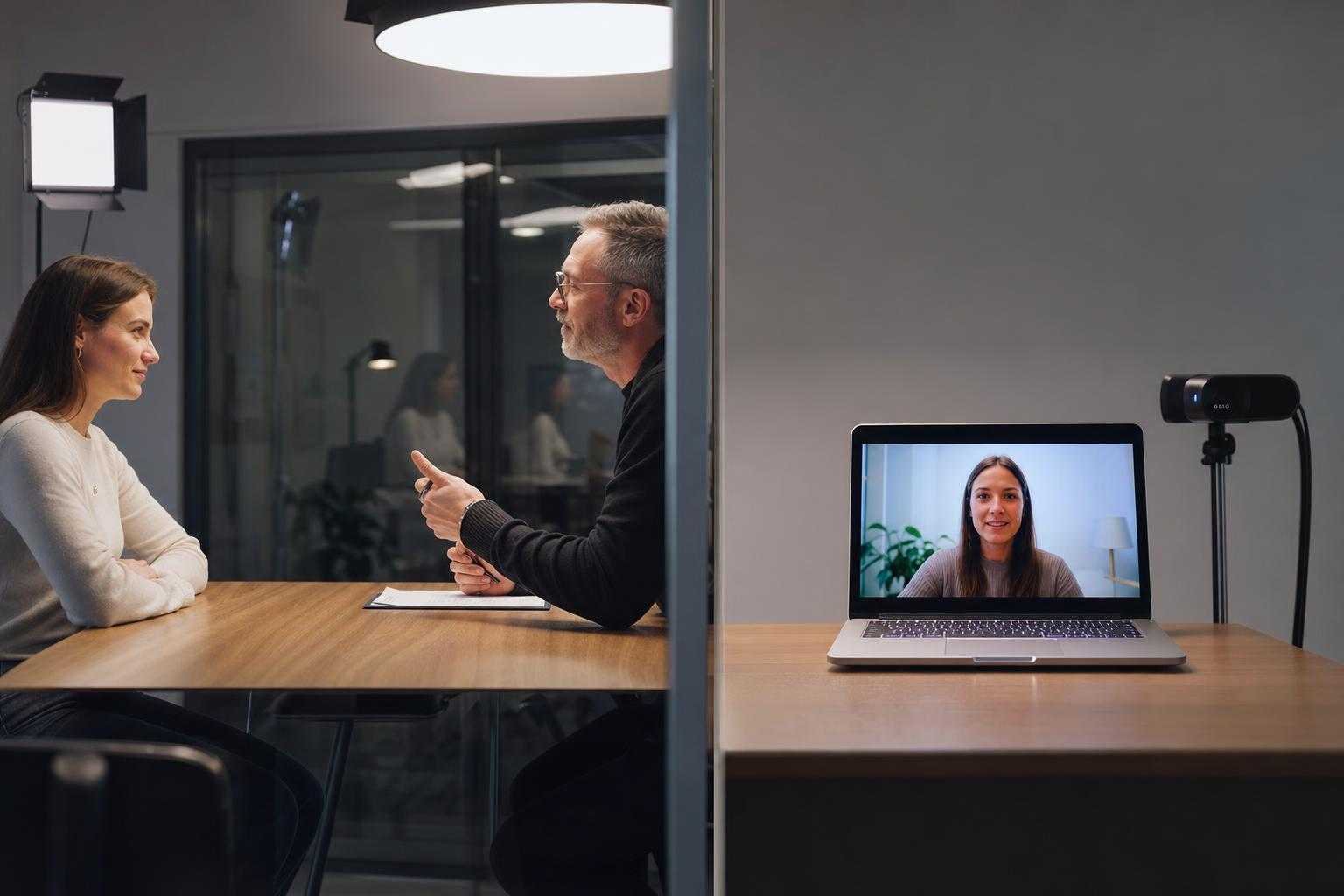
AI moderation wins on cost, speed, scale, and consistency. Human moderation wins on empathy, real-time reinvention, and domain depth. Neither is "better" in the abstract. The right choice depends on what your specific study needs, and the most common answer at mature teams is "both, for different studies."
The comparison, dimension by dimension
Cost
This is the most lopsided dimension. A human-moderated interview runs roughly $150 to $300 for a 30-minute session once you include recruiting, incentives, the moderator's time, and analysis. Scale that to 100 interviews and you are looking at $15,000 to $30,000. AI-moderated sessions run closer to $5 to $20 each, which puts the same 100-interview study in the $500 to $2,000 range. In round numbers, AI moderation costs five to ten percent of human moderation.
Edge: AI, by a wide margin.
Speed
A human study moves at the speed of calendars. You recruit, schedule around availability, run sessions one at a time, then transcribe and analyze, and the whole thing often takes two to three times longer than a semi-automated alternative. AI-moderated studies run in parallel and never need to find a mutual free hour. A study can launch on Friday evening and have 50 completed, synthesized interviews waiting on Monday. Across teams that adopted AI moderation, research cycles that used to take four to six weeks now finish in 24 to 48 hours.
Edge: AI, by a wide margin.
Depth and nuance
This is where it gets interesting, because the gap is smaller than skeptics expect but real. A good AI moderator follows a thread five to seven levels deep, which sits in the range of a skilled human interviewer, and one comparative study found AI interviews drew 129% more words per response than a survey, with 66% of transcripts rated higher quality. That is real depth.
A human still reads the room in a way no model matches. They catch the hesitation that means "there is more here," the sarcasm that flips a statement's meaning, the sigh that says the real problem is something the participant has not said yet. For the deepest exploratory work, that judgment is irreplaceable.
Edge: Human for the hardest exploratory work, closer than you would think everywhere else.
Consistency and bias
Counterintuitively, this favors the machine. Human moderators introduce variance: different people phrase questions differently, probe to different depths, and read answers through their own assumptions. Worse, humans fatigue. After four to six interviews in a day, moderators start leading the witness, asking questions that confirm a pet theory and contaminating the later sessions in a study. An AI moderator gives every participant the same tone, the same pacing, and the same branching logic, adapting its follow-ups by a shared, repeatable set of rules.
Edge: AI for consistency. Human judgment is a strength and a source of bias at the same time.
Empathy and trust
No contest the other way. Human moderators build rapport, offer reassurance, and create the safety that gets someone to open up about a personal or painful topic. Nielsen Norman Group's 2026 evaluation found participants actively held back sensitive information from an AI interviewer because the trust was not there. For anything emotionally charged, that alone settles it.
Edge: Human, clearly.
Adaptability to the unexpected
A human can throw out the discussion guide when a participant says something that changes the whole picture. An AI moderator probes well inside the topics you gave it, but it will not invent a new line of inquiry the brief never anticipated. NN/G's verdict was direct: AI interviewers "cannot meaningfully adapt" beyond their predefined guide. When you are mapping a problem space you do not understand yet, that ceiling matters.
Edge: Human.
The decision framework
Run your study through these questions in order. The first one that gives a clear answer usually decides it.
1. Is the topic sensitive or emotional? Trauma, health, money troubles, discrimination, identity. If yes, use a human. The trust gap is not worth the cost savings.
2. Are you exploring a problem space you do not yet understand? If you cannot yet write a decent question guide because you do not know what to ask, use a human who can adapt in real time. Once the space is mapped, AI can take over the follow-up studies.
3. Does the session require observation or specialized expertise? Screen-sharing, watching someone complete a task, or interviews that hinge on deep industry jargon point to a human.
4. Do you need scale, speed, or a tight budget? If the topic is reasonably well-defined and you want 50 or 200 conversations, fast or cheap, use AI. This covers a large share of everyday product research: feature feedback, concept tests, churn reasons, onboarding friction.
5. Do you need consistency across many sessions or many languages? If removing moderator variance matters, or you need to interview across languages without a translator, use AI.
If you reach question 4 without a clear "human" answer, AI moderation is very likely the right call.
The answer is usually "both"
Framing this as AI versus human is useful for a single study and misleading as a long-term strategy. The strongest research programs use the two together:
- AI for breadth, human for depth. Run a large AI-moderated study to find the patterns, then a few human sessions to go deep on the most important or most surprising ones.
- AI to screen, human to interview. Let an AI conversation confirm eligibility and surface the most interesting participants, then put your researcher's time only where it pays off.
- AI for the continuous baseline, human for the big strategic questions. Keep always-on AI research running so you always have a current read, and reserve human moderation for the launches and pivots where the stakes justify it.
Used this way, AI moderation frees your researchers from the interviews a script could have run, so they can spend their judgment where judgment is the whole point.
How to decide for your next study
Start from the work, not the tool. Write down what a successful study would tell you, then walk the five questions above. If you are new to either method, our guides on how to conduct effective user research and the broader types of user research cover the fundamentals that apply no matter who, or what, runs the session. And if you want the full picture on how the automated side actually works, start with what AI-moderated interviews are and how they work.
With User Evaluation you can run AI-moderated interviews for the breadth-and-speed studies and bring your own human sessions into the same workspace for analysis, so the AI-versus-human choice becomes a per-study decision rather than a per-tool one.
Where this leaves you
AI moderators are fast, cheap, consistent, and good enough on depth to handle most everyday product research. Human moderators bring the empathy, adaptability, and expertise that the hardest studies still depend on. So stop asking which one is better. Ask what this study needs, send the well-defined, high-volume work to AI, keep the sensitive and exploratory work with a person, and spend the time you save where it actually moves the product.